
If you are researching how to microneedle face safely and effectively, you are already thinking about this the right way. Microneedling is not simply rolling needles across your skin and hoping for the best. It is a controlled wound-healing procedure that triggers your body's own collagen production - and your results depend on understanding technique, device choice, depth, frequency, and proper microneedling aftercare. This guide is built entirely on peer-reviewed science to give you a structured approach to post-treatment care and the full treatment process from preparation through recovery.
Below, we break down everything: how microneedling works at a cellular level, how to actually perform it with different devices, what to expect during healing, what influences your outcomes, and where the science is clear versus where evidence is limited.
Don't guess your recovery. Download FREE Clinical Microneedling Protocol Here
What Is Microneedling and Why Does It Work?
Microneedling - also called percutaneous collagen induction therapy - uses fine needles to create controlled micro-injuries in the skin. These tiny punctures trigger your body's wound-healing cascade: platelets activate, growth factors release, fibroblasts get to work, and new collagen and elastin fibers form over the following weeks (1, 2).
The critical distinction from ablative procedures is that microneedling does not remove the epidermis. The surface remains largely intact while the deeper layers undergo remodeling. This is what gives microneedling its relatively short downtime compared to laser resurfacing or chemical peels, while still producing measurable improvements in scar texture, fine lines, and overall skin quality.
The Science of Skin Response During and After Microneedling
Understanding what happens beneath the surface helps you make better decisions about depth, frequency, and aftercare.
During treatment, needles penetrate the epidermis and upper dermis, creating microchannels. This immediately activates platelet degranulation and initiates an inflammatory cascade. Growth factors including platelet-derived growth factor (PDGF) and transforming growth factor (TGF) begin the signaling process that leads to new collagen synthesis (1, 4).
After treatment, you can expect immediate erythema (redness), transient swelling, and mild pinpoint bleeding depending on the depth used. The skin barrier is disrupted for approximately 24-48 hours, which is both the reason serums can penetrate more effectively and why you need to be extremely careful about what touches your skin during this window.
| Timeline | What Happens |
|---|---|
| 0-24 hours | Redness, tightness, mild swelling |
| 24-48 hours | Barrier repair begins, redness fading |
| 3-5 days | Mild flaking, peeling possible |
| 2-8 weeks | Active collagen remodeling beneath the surface |
Types of Microneedling Devices
Not all microneedling tools work the same way, and the device you choose meaningfully impacts your results and risk profile, (4).
| Device | Mechanism | Depth Control | Precision | Risk Profile |
|---|---|---|---|---|
| Pen (motorized) | Vertical stamping | High - adjustable | High | Moderate |
| Roller | Manual rolling | Limited - fixed | Lower | Higher tearing risk |
| Stamp | Manual vertical press | Moderate | Moderate | Lower than roller |
How To Microneedle Face Correctly?
Proper technique is what separates productive microneedling from unnecessary skin trauma. Here is the evidence-based approach (1, 4):
1️⃣ Preparation
- Cleanse skin thoroughly - no makeup, no residue
- Disinfect your device according to manufacturer instructions
- Do not treat over active infections, open wounds, or inflamed acne
2️⃣ Section your face into zones
Work systematically through forehead, each cheek, chin, and nose. Treating zone by zone prevents overlap and ensures even coverage.

3️⃣ Use a cross-hatch pattern
Pass the device vertically, horizontally, and diagonally across each zone. This creates a more uniform distribution of microchannels rather than parallel tracks.

4️⃣ Know your endpoint
You are looking for uniform pinkness (erythema) across the treated area. Mild pinpoint bleeding may occur at deeper settings but should not be your goal for at-home treatments. If you see pooling blood, you have gone too deep.

How To Microneedle Face With Pen
Microneedling pens are motorized devices that stamp needles vertically into the skin at adjustable depths, typically ranging from 0.25mm to 2.5mm. The vertical needle entry is the key advantage - it creates clean, perpendicular microchannels rather than the angled entry that rollers produce (1, 2).
Pens are particularly well-suited for acne scars, wrinkles, and areas with texture irregularities because you can adjust depth zone by zone. Thinner skin around the eyes might need 0.25-0.5mm, while thicker cheek skin can tolerate more. The precision comes at a cost, though - outcomes are highly operator-dependent. Moving too slowly concentrates trauma in one area, while moving too fast creates insufficient coverage.
How to use it: Hold the pen perpendicular to the skin. Glide it across each zone at a steady, moderate pace - not pressing down, letting the motor do the work. Adjust depth as you move between facial zones. Two to four passes per zone in the cross-hatch pattern described above is typically sufficient.
How To Microneedle Face With Roller
Derma rollers are the most accessible and affordable microneedling tools, but they come with inherent limitations. Because the needles are fixed to a rotating barrel, they enter the skin at an oblique angle rather than perpendicularly. This creates a slight lateral tearing motion that can result in more epidermal damage and less precise microchannel formation (4).
That said, rollers can still be effective for general skin rejuvenation at shallower depths (0.25-0.5mm). The key is technique: use light, consistent pressure and do not press the roller into the skin aggressively. Roll 4-6 times per direction in each zone. Replace roller heads regularly - dull needles cause more tearing and increase infection risk.
How To Microneedle Face With Stamp
Stamp devices operate on the same vertical-entry principle as pens but without motorization. You press the stamp straight down onto the skin, lift, and reposition. This makes stamps particularly useful for targeted treatment of individual scars or small problem areas where a roller would unnecessarily treat surrounding skin (1).
The trade-off is speed - treating a full face with a stamp is slow and labor-intensive. Stamps also require consistent manual pressure, which introduces variability. For best results, use stamps as a complementary tool for focused scar work rather than as your primary full-face device. Press firmly but evenly, and avoid stamping the same spot repeatedly without repositioning.
How To Use Geske Microneedle Face Roller
The Geske microneedle roller follows the same mechanical principles as standard derma rollers, so the core technique applies: sanitize before and after use, work in sections, roll 4-6 passes per direction using the cross-hatch pattern, and apply light-to-moderate pressure only (4).
A few specific considerations for at-home roller use: always avoid the immediate eye area (eyelids and orbital bone), replace the roller head according to manufacturer guidelines since needle dullness is not always visible, and never share your device. After each session, rinse the roller head, spray with a recommended disinfectant solution, and store it in its protective case. Compromised hygiene is one of the most common causes of post-procedure infection in at-home microneedling.
How Long Microneedling Face Should Take?
A full-face at-home session typically takes 20-40 minutes, depending on the device, needle depth, and how methodically you work through each zone. Professional treatments often take longer because they may involve topical anesthesia application and wait time, higher depth settings requiring more careful technique, and additional passes (1).
Do not rush. Consistent, even coverage matters more than speed. If you find yourself finishing in under 15 minutes on a full face, you are likely not being thorough enough with your cross-hatch pattern.
How To Apply Microneedling Serum On Face?
The microchannels created during treatment temporarily increase transdermal absorption, which means whatever you apply immediately after treatment will penetrate more deeply than it normally would. This is both an opportunity and a risk (1, 4).
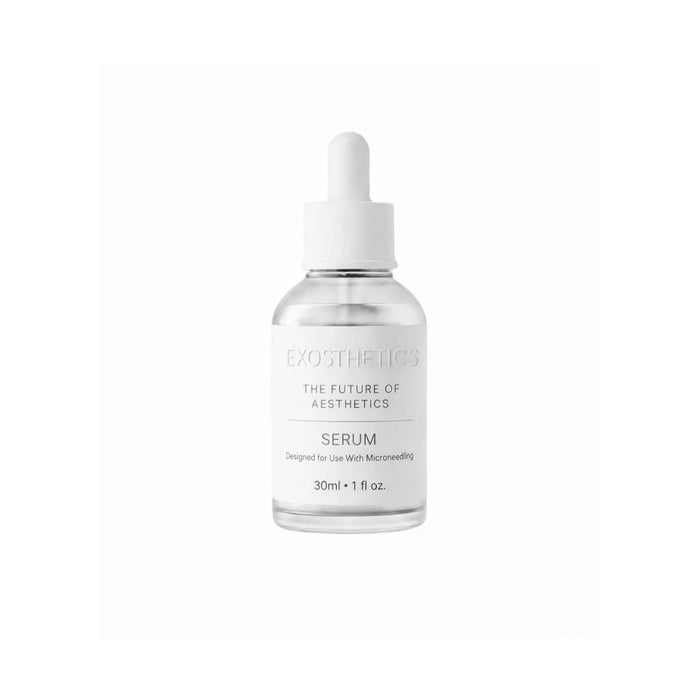
What to use → Only sterile, purpose-formulated serums designed for post-microneedling application. Hyaluronic acid-based serums are widely used because they support hydration and barrier recovery without irritation. A formulation like the Exosthetics Microneedling Serum is designed specifically for post-treatment application, supporting the skin during the critical 24-48 hour recovery window using advanced exosome technology.
What to avoid → Retinoids, vitamin C at high concentrations, AHAs/BHAs, fragrance, essential oils, and any product not specifically formulated for use on compromised skin. The enhanced absorption that makes serums effective also makes irritants more dangerous.
Apply serum gently with clean hands immediately after treatment. Pat - do not rub. Let the serum absorb fully before applying any additional barrier products.
How To Microneedle Face For Wrinkles
Microneedling addresses wrinkles through its core mechanism: fibroblast activation and subsequent collagen remodeling. As new collagen and elastin fibers form over weeks following treatment, fine lines soften, skin texture improves, and mild laxity can improve (2).
This is not a one-session transformation. Collagen remodeling is a gradual biological process, and most clinical studies showing significant improvement in fine lines and wrinkles involve multiple treatments spaced 4-6 weeks apart. Expect subtle, progressive improvement rather than dramatic overnight change. Microneedling will not replace surgical lifting for significant laxity or deep structural folds, but for fine-to-moderate lines it is one of the more evidence-supported minimally invasive options available.
How To Microneedle Face For Acne Scars
Atrophic acne scars - the depressed, textured scars left after inflammatory breakouts - are one of the best-supported indications for microneedling. The collagen remodeling process can gradually raise depressed scar tissue and smooth the surrounding texture (2, 5).
Results are strongest for rolling and boxcar scars. Ice pick scars - narrow, deep, and sharply defined - respond less predictably because the scar architecture is harder for new collagen to reshape. Multiple sessions are needed, and professional-depth treatments typically outperform at-home devices for significant scarring. If your primary concern is acne scarring, a pen device gives you the precision and depth control to target individual scars more effectively than a roller.
How To Microneedle Face And Neck
Extending microneedling from the face to the neck is common, but the neck requires a distinctly different approach. Neck skin is thinner, has less subcutaneous support, and tends to stay red longer after treatment (1).
Reduce your needle depth by at least one setting compared to what you use on the cheeks. Use lighter pressure and fewer passes - three per direction is typically sufficient for the neck. Expect erythema to last longer on the neck compared to the face, sometimes an additional 12-24 hours. The neck also tends to be more sensitive, so if you are new to microneedling, master your face technique first and add the neck in after a few sessions once you understand how your skin responds.
Avoid the thyroid area and be cautious around the sides of the neck where skin is especially thin. The same aftercare rules apply: gentle cleanser, sun protection, no actives.
Skin Type Considerations and PIH Risk
One of the most clinically important factors that many microneedling guides overlook is skin type - specifically, the risk of post-inflammatory hyperpigmentation (PIH) in darker skin tones. Individuals with higher Fitzpatrick skin types (IV-VI) face a meaningfully increased risk of PIH following any procedure that creates controlled inflammation, including microneedling (4).
This does not mean microneedling is unsafe for darker skin. In fact, because it preserves the epidermis, it carries lower PIH risk than ablative laser treatments. But it does mean you should start with conservative depths, space treatments further apart to ensure complete healing, and be especially vigilant about sun protection during recovery. If you notice any darkening of treated areas, pause treatments and consult a dermatologist before continuing.
Frequency, Cumulative Effects, and Realistic Expectations
Collagen remodeling takes time - the biological process cannot be rushed by treating more frequently. The standard recommendation is 4-6 weeks between sessions, which allows the full inflammatory-proliferative-remodeling cascade to complete before introducing new controlled injury (1, 2).
The results of microneedling are cumulative - each session builds on the collagen laid down by the previous one. But this cumulative benefit only works when treatments are properly spaced. Treating too frequently does not accelerate results. Instead, it prolongs inflammation, compromises barrier function, and can actually worsen skin quality by preventing the remodeling phase from completing. More is not better; consistent and spaced is better.
What microneedling can realistically achieve:
✔ Improved skin texture and smoothness
✔ Softening of fine lines and mild wrinkles
✔ Gradual improvement of atrophic acne scars
✔ Enhanced product absorption
What it cannot do:
✖ Replace surgical lifting for significant laxity
✖ Completely eliminate deep structural scars
✖ Produce dramatic overnight results
✖ Treat active inflammatory acne
Microneedling Aftercare Essentials
Recovery quality directly influences your long-term outcome. The 48 hours after treatment are when your skin barrier is most vulnerable, and what you do - or do not do - during this window can make or break your results (1).
Do:
- Use a gentle, fragrance-free cleanser
- Apply a barrier-supporting serum or moisturizer
- Wear broad-spectrum SPF 30+ daily (non-negotiable)
- Keep skin hydrated
- Sleep on a clean pillowcase
Do not:
- Apply exfoliants, retinoids, or acids for at least 48-72 hours
- Exercise intensely or use saunas for 24 hours (sweating on open microchannels increases infection risk)
- Expose treated skin to direct sun without protection
- Use makeup for the first 12-24 hours
- Touch your face with unwashed hands
What Influences Outcomes?
Results from microneedling are not random - they are shaped by a specific set of controllable and biological variables (1, 4):
- Needle depth - too shallow delivers minimal stimulus; too deep causes unnecessary inflammation
- Technique - even, systematic coverage versus haphazard passes
- Device type - pen, roller, and stamp each have different precision profiles
- Skin type - Fitzpatrick type influences healing speed and PIH risk
- Aftercare compliance - sun protection and gentle care during recovery
- Treatment spacing - respecting the 4-6 week interval
What Is Normal vs. Not Normal After Treatment
Normal: Redness lasting 24-48 hours, mild tightness, slight swelling, light flaking around days 3-5, and temporary sensitivity. These are signs the healing cascade is working as intended.
Not normal: Persistent swelling beyond 72 hours, increasing pain after day 2, signs of infection (warmth, pus, spreading redness), or new darkening of treated skin (possible PIH). If any of these occur, stop future treatments and consult a healthcare provider (4).
When Is Microneedling Ineffective?
Transparency matters. Microneedling has limited evidence for deep tethered scars that are anchored to underlying tissue, severe skin laxity that requires structural support, active inflammatory acne (microneedling may worsen it), and ice pick scars, which have a narrow and deep architecture that is difficult for new collagen to reshape (2).
If your primary concerns fall into these categories, discuss alternative or combination approaches with a dermatologist rather than expecting microneedling alone to deliver results.
FAQ
How often to microneedle face at home?
Every 4-6 weeks is the recommended interval. Collagen remodeling requires this time to complete, and treating more frequently can prolong inflammation and impair results rather than improve them.
Can you microneedle your face every day?
No. Daily microneedling prevents the skin from completing its healing cycle, increases the risk of chronic inflammation, compromises the skin barrier, and can lead to worsened skin quality over time.
How do I microneedle my face at home?
Cleanse your face, disinfect your device, treat in sections using a cross-hatch pattern with appropriate pressure, and follow strict aftercare including gentle cleanser, hydrating serum, and sun protection.
How often should I microneedle my face at home before seeing results?
Most people begin noticing improvements after 2-3 sessions spaced 4-6 weeks apart. Significant scar or wrinkle improvement typically requires 4-6 sessions as collagen builds cumulatively.
What should you put on your face before microneedling?
Clean skin only. Avoid retinoids, acids, and irritants for at least 24-48 hours before treatment. Some practitioners apply a hyaluronic acid serum as a glide medium during treatment.
Where do you microneedle on the face?
Forehead, cheeks, chin, and nose. Avoid eyelids, lips, and any areas with active lesions, open wounds, or inflammatory acne.
🔗 References
- Microneedling. StatPearls [Internet]. Treasure Island (FL): StatPearls Publishing. Available from: https://www.ncbi.nlm.nih.gov/books/NBK459344/
- Aust MC, et al. Percutaneous collagen induction therapy: an alternative treatment for scars, wrinkles, and skin laxity. Plast Reconstr Surg. 2008. PMID: 28796657. Available from: https://pubmed.ncbi.nlm.nih.gov/28796657/
- PMC12621213. Available from: https://pmc.ncbi.nlm.nih.gov/articles/PMC12621213/
- Singh A, Yadav S. Microneedling: Advances and widening horizons. Indian Dermatol Online J. 2016. Available from: https://pmc.ncbi.nlm.nih.gov/articles/PMC4976400/
- PMC12456936. Available from: https://pmc.ncbi.nlm.nih.gov/articles/PMC12456936/

The first week
Everything in this guide, in two products
Exosome Serum for the night of. 72-Hour+ Cream from day three. $99 together — and you can add Ceramide Repair, the day-7 step, for $35 instead of $49.
See the Kit — $99