
Microneedling arms has become one of the most searched cosmetic procedure terms for people dealing with arm texture issues, crepey appearance, scarring, and stretch marks. Whether you've been scrolling through before-and-after photos or heard about it from a friend who swears by the results, you're probably wondering what this procedure can realistically achieve on arm skin - and what it simply cannot. The answer depends on the device, the depth, the specific concern you're targeting, and your post-treatment care and microneedling aftercare protocol.
This guide breaks down what's known, what's not, and where the evidence gaps are. We'll be direct with you from the start: the clinical research base specific to cosmetic microneedling on arms is thinner than most marketing materials would have you believe. The strongest evidence for microneedling efficacy comes from facial studies and from scar and stretch mark research conducted across multiple body sites. Where we have directly relevant data, we cite it. Where we lack it, we say so plainly and redirect you to actionable guidance grounded in what the science does support.
The studies informing this article include a comprehensive dermatology review of microneedling across all indications (Hou et al., 2017), a large prospective observational study of microneedling for facial and nonfacial scars across skin phototypes I through VI (Alster & Li, 2020), a clinical pilot study of microneedling for striae distensae covering both striae rubra and striae alba (Park et al., 2012), and the broader mechanism and collagen-induction literature referenced throughout. Where arm-specific controlled trial data is absent, that limitation is stated explicitly.
Don't guess your recovery. Download FREE Clinical Microneedling Protocol Here
What "Microneedling Arms" Actually Means
When you search "microneedling arms," you're thinking about a cosmetic procedure - a pen or roller device creating controlled micro-injuries in your skin to trigger your body's natural collagen production. That's percutaneous collagen induction therapy (PCI), and it's a well-characterized procedure with a growing evidence base across multiple dermatologic conditions.
The mechanism is more precisely understood than most guides let on. Microneedling uses fine needles to puncture the epidermis, creating microwounds that stimulate the release of growth factors and induce collagen production. Critically, the epidermis remains relatively intact throughout - which is what limits adverse events and keeps recovery time short compared to ablative procedures like laser resurfacing (Hou et al., 2017). The controlled micro-injury triggers the wound healing cascade: inflammation, proliferation, and remodeling, resulting in new collagen and elastin deposition in the dermis.
What that means practically is that microneedling works at the dermal level - the structural layer beneath your skin's surface. This is relevant to almost every arm concern we'll discuss, because it determines what the procedure can and cannot physically reach.
Why Arms Are Different From Face: Skin Thickness, Healing, and Exposure
If your dermatologist or aesthetician has experience microneedling faces, that expertise doesn't automatically translate to arms. Arm skin presents a fundamentally different treatment landscape, and understanding why will help you set realistic expectations and ask better questions during your consultation.
Arm skin varies dramatically by zone. The inner upper arm - the area most people point to when they complain about crepey texture or laxity - has relatively thin skin overlying a subcutaneous fat layer. The outer upper arm is thicker, more frequently sun-exposed, and prone to conditions like keratosis pilaris. The dorsal forearm (the top, sun-facing side) accumulates significant UV damage over a lifetime and is where visible scarring and pigmentation changes tend to be most prominent. The ventral forearm (the inner, softer side) is thinner, more vascular, and a common site for stretch marks.
Each of these zones has different sebaceous gland density, collagen architecture, and healing characteristics. A blanket approach that ignores these differences is like using the same brush for detail work and wall coverage - technically possible, practically suboptimal.
There are also practical recovery differences that don't apply to the face. Arms experience more friction from clothing. Forearms get more incidental UV exposure during daily activities - every drive to work, every walk outside. Healing on arms tends to be visually slower than on the face, which benefits from richer blood supply. These factors directly affect post-treatment care planning, and a provider who doesn't account for them is skipping an important step in your protocol.
Arm Zone Quick Reference:
- Inner upper arm: thin skin, common crepey concern, less sun-exposed
- Outer upper arm: thicker skin, sun-exposed, keratosis prone
- Forearm dorsal: high UV accumulation, visible scarring and pigmentation zone
- Forearm ventral: thinner, more vascular, stretch mark zone
Can Microneedling Be Done On Arms?
The short answer is yes - microneedling can be and is performed on arms in clinical settings. Importantly, the scar study by Alster & Li (2020) treated both facial and nonfacial scars across 120 patients and found no significant clinical differences in treatment response between facial and nonfacial locations - meaning the procedure is not inherently less effective just because you're treating body skin rather than the face. That's a meaningful finding that counters the assumption that arms are somehow outside the scope of what microneedling can address.
But that finding is specific to scars. Whether microneedling produces equivalent results across all arm concerns - crepey skin, laxity, stretch marks, pigmentation - is a separate question that requires concern-specific evidence. The sections below address each individually.
Before booking, discuss the following with your provider:
- Active infection, eczema, or psoriasis flare on the treatment area
- Recent significant UV damage or sunburn
- Blood-thinning medications
- History of keloid scarring
- Immunosuppression or autoimmune conditions
These are general safety considerations for any skin-penetrating procedure. A qualified provider will conduct their own assessment, but arriving informed makes the consultation more productive.
Does Microneedling Work On Arms?
The honest answer requires you to define what "work" means for your specific situation, because "microneedling arms" covers an enormous range of different biological goals.
Consider what people actually want when they search this term: smoother texture, reduced crepiness, less visible scars, improvement in stretch mark appearance, more even tone. Each of these is a different biological endpoint requiring a different mechanism of action - and each has a different evidence status.
What we can say with confidence, grounded in the literature: microneedling has demonstrated efficacy for scars across facial and nonfacial sites, with meaningful outcome data. It has demonstrated efficacy for striae distensae (stretch marks) in a clinical pilot study with histological confirmation. It has a well-characterized mechanism of action that is biologically plausible for improving skin texture and mild laxity. What remains less established is the degree of improvement you can expect on arm skin specifically, for each specific concern, at what depth, over what timeline - because dedicated arm-specific controlled trials are sparse.
Define your goal before evaluating "does it work":
- "I want smoother texture" involves epidermal turnover and superficial collagen remodeling
- "I want tighter skin" involves deep dermal structural integrity and tissue mechanics
- "I want less visible scars" involves scar-specific remodeling and pigment regulation
- "I want stretch marks less visible" involves dermal rupture repair - a different pathology than surface texture
- "I want less arm fat" involves subcutaneous adipose tissue - not addressable by microneedling at all
Each goal operates through a different biological pathway. The sections below address the ones with clinical support.
Can Microneedling Help Crepey Arms?
Crepey arms are one of the most commonly cited reasons people explore microneedling for this body area. That thin, crinkled appearance on the upper arms - sometimes called tissue-paper skin - is a source of significant self-consciousness, particularly after significant weight loss or with advancing age.
Understanding what causes it helps explain both the theoretical promise and the practical limitations. Crepey skin results from dermal collagen and elastin degradation combined with epidermal thinning. This is a structural problem - not a surface issue that can be buffed away. Years of UV exposure, natural aging, and genetic predisposition all contribute to the breakdown of the scaffolding that keeps skin plump and resilient.
Microneedling's mechanism - controlled micro-injury triggering the wound healing cascade, which stimulates neocollagenesis - is biologically plausible for early-stage crepey changes where there is still sufficient dermal substrate to respond to injury signals. El-Domyati et al. (2015) confirmed histologically that microneedling produces statistically significant increases in collagen types I, III, and VII as well as tropoelastin - which is exactly the structural rebuilding that crepey skin needs. That said, this plausibility has diminishing relevance as structural loss advances. A patient with mild textural changes has more biological raw material for remodeling than someone with advanced laxity and significant dermal atrophy.
No controlled trial data exists specifically for crepey arm outcomes. The realistic framing: if your crepey changes are mild to moderate and you have realistic expectations about incremental improvement rather than dramatic transformation, a consultation with a qualified provider is reasonable. If your skin has advanced structural thinning and significant elastin loss, microneedling alone is unlikely to produce the visible change you're hoping for.

Can Microneedling Help Saggy Arms?
Sagging and crepiness often get conflated, but they represent different problems with different underlying causes - and this distinction matters enormously for treatment planning.
Skin laxity on arms involves loss of dermal structural integrity, subcutaneous fat redistribution, and gravitational tissue descent. Crepey skin is about the quality of the fabric. Saggy skin is about the fabric being too loose for the frame. Microneedling targets the dermal layer - the skin itself. It does not address fascial laxity (the deeper connective tissue layer), fat volume changes, or muscle tone, all of which contribute to the saggy arm appearance.
Even if microneedling improves surface texture - and it may - it will not replicate the mechanical lifting effect of surgical procedures like brachioplasty or the tissue contraction achieved by energy-based devices such as radiofrequency or ultrasound-based systems that work at deeper tissue levels.
If true structural sagging is your primary concern, microneedling is likely not your most effective standalone option. An honest provider will tell you this during consultation, and that honesty is a sign you've found the right person to work with.
Microneedling Arm Scars
Scar remodeling is one of the best-supported applications for microneedling, and - critically - the evidence explicitly covers nonfacial as well as facial scars. Alster & Li (2020) conducted a prospective observational study of 120 consecutive patients with scars from acne, trauma, and surgery, across all skin phototypes from I to VI. Patients received one to six monthly microneedling sessions using a mechanical device with no additional topical or intralesional treatments. All scars improved by at least 50% after an average of 2.5 treatments. Over 80% of patients showed 50 to 75% improvement, and 65% demonstrated over 75% improvement. The study found no significant clinical differences in treatment response between facial and nonfacial scars.
That last finding is directly relevant to arms. It means the evidence base for scar improvement is not limited to the face - your arm scars fall within the scope of what the research supports.
Scar type matters enormously, however. Atrophic scars (depressed, pitted) respond differently than hypertrophic scars (raised, thickened), which respond differently than keloids (aggressively overgrown scar tissue), and all of these respond differently than post-inflammatory hyperpigmentation (dark marks left after healing). Keloid scarring in particular is a contraindication rather than an indication - microneedling in keloid-prone patients risks worsening rather than improving the outcome.
One additional consideration specific to arms: arm scars are subject to more mechanical tension and movement than facial scars. Every time you bend your elbow, reach for something, or carry a bag, the skin on your arms stretches and contracts. This ongoing mechanical stress affects remodeling biology and may influence both treatment outcomes and recovery timeline.
Microneedling Arm Stretch Marks
Stretch marks - medically known as striae distensae - are among the most common reasons people explore microneedling for their arms, particularly on the inner upper arms and bicep area. Park et al. (2012) conducted a clinical pilot study of 16 patients with striae distensae (both striae rubra and striae alba) treated with a disk microneedle therapy system at 4-week intervals over three sessions. Results showed marked to excellent improvement in 43.8% of patients and minimal to moderate improvement in the remaining patients. Patient satisfaction scores showed 37.5% highly satisfied and 50% somewhat satisfied. Skin biopsies confirmed histological improvement. The procedure was well-tolerated, with side effects limited to mild pain, erythema, and spotty bleeding.
This is real, directly relevant clinical evidence - not theoretical extrapolation. But it also illustrates the ceiling: marked to excellent improvement in fewer than half of patients, with no patients experiencing complete elimination of stretch marks.
Understanding what stretch marks actually are helps explain why. Striae are dermal ruptures - actual tearing of the collagen and elastin fibers in the dermis. This is a fundamentally different pathology than surface texture irregularities or pigment changes. The age of your stretch marks also matters. Striae rubra (newer marks that appear red, purple, or pink) still have active blood supply and inflammatory activity, which provides more biological substrate for remodeling. Striae alba (mature marks that have faded to white or silver) have completed their healing cycle and contain less metabolically active tissue to stimulate - which is reflected in the general clinical consensus that newer stretch marks respond more favorably to treatment.
The realistic expectation: meaningful improvement in texture and visibility is achievable for many patients, particularly with newer striae. Complete disappearance is not a realistic goal with any current non-surgical treatment, including microneedling.
Microneedling Arm Fat
This may be the single most important expectation to correct in this entire guide: microneedling cannot reduce arm fat, and any claim suggesting otherwise should be treated as a credibility red flag.
Microneedling devices operate at the epidermal-dermal interface. Subcutaneous adipose tissue sits beneath these layers in a completely different tissue compartment. No mechanism in the microneedling literature suggests that creating micro-injuries in the skin surface affects the fat layer below it. This is not an evidence gap waiting to be filled - it is a fundamental mismatch between what the device does and what the concern requires.
Arm fat concerns involve subcutaneous fat volume and distribution, which are addressed by entirely different interventions: caloric deficit and exercise for overall fat reduction, liposuction for targeted removal, or cryolipolysis and similar technologies for non-surgical fat reduction. Microneedling addresses skin quality, not tissue volume.
How To Microneedle Arms
Rather than a step-by-step protocol - which no referenced study describes specifically for cosmetic arm microneedling - here is a decision-making framework for approaching the process intelligently.
Step 1: Define the concern precisely. Are you targeting texture, scars, stretch marks, or pigmentation? Each requires a different approach, and some concerns have stronger evidence than others. Go into any consultation knowing what you're trying to achieve.
Step 2: Choose the setting deliberately. Medical office procedures allow for deeper needle depths, professional-grade devices, combination therapies, and clinical supervision. Home devices are limited to shallower depths and carry different risk profiles. The right setting depends on your specific concern and how deep the treatment needs to go.
Step 3: Establish provider qualifications. Verify your provider's training, their experience with body (not just facial) microneedling, and the specific device they use. The Alster & Li (2020) scar study used a mechanical microneedling device without additional adjunctive treatments and still achieved strong outcomes - the device selection and technique matter.
Step 4: Plan your post-treatment care before your first session. Your microneedling aftercare protocol should be established before the first needle touches your skin, not figured out afterward. Arms require specific aftercare considerations that facial protocols don't fully address.
Stop indicators - when NOT to proceed:
- No provider consultation has occurred
- Active skin condition present in the treatment area
- No aftercare plan established
- Device sterility is uncertain
- You are self-treating at depths greater than 0.5mm without professional training
Microneedling Arms Depth
Needle depth is one of the most critical variables in any microneedling treatment, and it is not a one-size-fits-all decision. Depth should match the target tissue layer and the specific concern, as determined by a trained provider. Deeper is not better. Unnecessarily deep treatment increases pain, downtime, bleeding, and complication risk without proportional benefit.
General depth ranges and their relevance to arm concerns:
- 0.25 to 0.5mm targets the epidermis and is primarily used for product penetration enhancement and superficial texture improvement. Appropriate for at-home devices.
- 0.5 to 1.0mm reaches the papillary dermis and is the primary zone for collagen stimulation in texture and mild crepiness concerns. Standard professional range for general rejuvenation.
- 1.0 to 2.0mm reaches the reticular dermis and is the scar remodeling zone. The Park et al. (2012) stretch mark study used this depth range. Higher risk, professional only.
- Above 2.0mm is not standard for cosmetic microneedling in most arm concerns. Deep dermis and subcutaneous targets require different modalities.
Your provider should determine the appropriate depth based on your skin assessment, the specific zone being treated, and the concern being targeted. The inner arm, being thinner, requires different depth calibration than the outer arm or forearm.
Pre-Treatment Preparation
In the weeks before treatment, protect the treatment area from excessive sun exposure. Significantly UV-damaged skin is more vulnerable to complications including post-inflammatory hyperpigmentation. In the days before, avoid retinoids, exfoliating acids, and NSAIDs per your provider's guidance. On the day of treatment, arrive with clean skin free of lotions, oils, or fragrance on the treatment area.
Discuss anesthesia options with your provider. Most providers apply a topical numbing cream 30 to 45 minutes before treatment. In the Alster & Li (2020) scar study, the procedure was well-tolerated across all 120 patients without reports of significant pain-related adverse events, suggesting that standard anesthesia protocols are sufficient for most patients.
Questions to ask your provider before treatment:
- What device and depth will you use on my arms specifically?
- How many sessions do you anticipate for my specific concern?
- What does your post-treatment care protocol include?
- What results can I realistically expect, and over what timeline?
- What are the signs I should contact you about post-treatment?
Microneedling Arms At Home
The at-home microneedling market has expanded significantly, and many people are using derma-rollers and pen devices on their arms without professional supervision. Here is what you need to know before joining them.
Home devices typically operate at 0.25 to 0.5mm - depths appropriate for product penetration enhancement and superficial texture improvement, but below the threshold for meaningful collagen induction or scar remodeling. At these depths, you are primarily affecting the epidermis and may enhance the absorption of your serums and topicals. Whether this produces meaningful cosmetic change on arm skin specifically is not well-quantified in controlled research.
The infection risk from any skin-penetrating device is real. The skin barrier exists for a reason, and piercing it in a non-clinical environment without professional sterilization protocols creates contamination risk. Home devices require strict hygiene: never reuse needles beyond manufacturer recommendations, sanitize the device before and after each use, never use on broken or irritated skin, and establish a microneedling aftercare routine before you begin.
A realistic comparison:
- Professional setting: depths of 0.25 to 2.5mm (provider-determined), clinical-grade sterilization, trained and consistent technique, immediate response to complications, higher per-session cost, moderate to significant outcomes depending on concern.
- At-home setting: depths of 0.25 to 0.5mm (device-limited), self-managed hygiene, variable self-taught technique, delayed self-assessed complication recognition, lower cost, minimal to mild outcomes.
If you have a concern that genuinely requires collagen induction - scar remodeling, stretch marks, significant crepiness - at-home devices operating at shallow depths are unlikely to produce the results you're looking for. For product delivery enhancement and general surface texture, they can be a reasonable addition to a skincare routine, provided hygiene is rigorous.
Microneedling Arms Before and After
If you've been searching for before-and-after photos of arm microneedling, you've likely noticed the results vary widely and most images lack standardized conditions. Before-and-after photography is not clinical evidence. Photos can be influenced by lighting changes, tanning, moisturizer application, camera angles, and the natural healing that occurs over time regardless of treatment. A six-month "after" photo compared to a "before" taken in different lighting tells you very little about what the microneedling itself accomplished.
Meaningful before-and-after evidence would include standardized clinical photography with consistent lighting, positioning, and camera settings; documentation of the specific device, depth, number of sessions, and all concurrent treatments; and ideally a split-arm design where one arm serves as an untreated control.
When evaluating provider galleries or social media results, ask:
- Were any other treatments performed simultaneously?
- How much time elapsed between photos?
- Are lighting and positioning standardized?
- Is this a typical result or a best-case selection?
- How many sessions were required?
The most honest providers show you a range of outcomes including cases where improvement was minimal, rather than only their most dramatic transformations.
Aftercare and Recovery: What Your Arms Need Post-Treatment
Aftercare for arm microneedling requires specific considerations that differ from facial post-treatment care protocols. Your face lives a relatively sheltered life compared to your arms - it's not rubbing against sleeves, resting on desk surfaces, or getting incidental sun exposure every time you step outside.
General post-treatment priorities for arms:
Keep the treated area clean and hydrated in the immediate post-procedure window. Apply a gentle, fragrance-free recovery serum, specialized microneedling serum or moisturizer as directed by your provider. Avoid tight or rough-textured clothing over the treatment zone for 24 to 48 hours. Apply broad-spectrum sunscreen diligently, especially on forearms - this is not optional. Avoid swimming pools, hot tubs, and gym equipment contact until the skin barrier has recovered. Follow your provider's specific product recommendations for the healing phase.
Active ingredients to avoid during the healing window include retinoids, AHAs, BHAs, and high-concentration vitamin C. These can cause burning, prolonged redness, and delayed healing when applied to skin with compromised barrier function.
General aftercare timeline (defer to your provider's specific instructions):
- Hours 0 to 6: redness, mild swelling, warmth are normal. Apply only approved recovery product.
- Hours 6 to 24: keep clean, apply recommended hydrating products only. No makeup over treatment area.
- Days 1 to 3: avoid sun, friction from clothing, active skincare ingredients, and swimming.
- Days 3 to 7: gradual return to normal skincare routine per provider guidance. Continue rigorous SPF.
- Weeks 2 to 4: sunscreen diligence, monitor for delayed reactions, reassess healing before considering next session.
One aspect of arm aftercare that is commonly underestimated: clothing friction. The rubbing of shirt sleeves, workout gear, and everyday fabric against freshly treated skin creates irritation risk that doesn't exist for the face. Choose loose, soft fabrics for the first several days post-treatment, and be conscious of how your arms contact surfaces throughout the day.
Summary
After reading this guide, here is where things stand for each common arm concern:
- Arm texture improvement: biologically plausible, supported by the general microneedling mechanism literature. Realistic expectation is mild to moderate improvement, not transformation. No arm-specific controlled trial data.
- Crepey arm skin: biologically plausible for mild to moderate cases with sufficient dermal substrate remaining. Histological evidence confirms microneedling increases collagen and elastin. Realistic expectation is incremental improvement. Advanced structural laxity will see limited response.
- Saggy arms: low plausibility for structural laxity. Microneedling targets the dermis and cannot address fascial laxity, fat redistribution, or gravitational tissue descent. Realistic expectation is surface texture improvement only, not lifting.
- Arm scars: well-supported by direct clinical evidence across facial and nonfacial sites. Alster & Li (2020) found over 80% of patients achieved 50 to 75% improvement. Realistic expectation is significant reduction in scar visibility over a series of monthly treatments, with outcomes depending on scar type.
- Arm stretch marks: supported by Park et al. (2012) pilot study with histological confirmation. Marked to excellent improvement in 43.8% of patients over three sessions. Realistic expectation is meaningful reduction in appearance, particularly for newer striae, not elimination.
- Arm fat reduction: no mechanism, no plausibility, no evidence. Zero effect. The wrong tool for this goal entirely.
Frequently Asked Questions
Can microneedling tighten loose skin on arms?
Microneedling targets the dermal layer and may improve skin texture and mild surface laxity, but it does not address the deeper structural causes of loose skin such as fascial laxity, fat redistribution, or gravitational tissue descent. For true structural sagging, surgical or energy-based tightening procedures are more appropriate interventions to discuss with a qualified provider.
How many microneedling sessions are needed for arms?
Session count depends on the specific concern. In the Alster & Li (2020) scar study, all scars improved by at least 50% after an average of 2.5 treatments, with patients receiving one to six monthly sessions. In the Park et al. (2012) stretch mark study, three treatments at 4-week intervals were used. For general texture improvement, most providers recommend three to six sessions spaced four to six weeks apart. Your provider should set expectations based on your specific concern and baseline skin condition.
Is microneedling arms painful?
Discomfort varies by individual pain tolerance, needle depth, and whether topical anesthesia is used. Most providers apply a topical numbing cream 30 to 45 minutes before treatment. In the Alster & Li (2020) scar study, the procedure was well-tolerated across 120 patients. Deeper needle depths increase discomfort; shallow home-device depths typically cause only mild prickling.
Can I microneedle my arms at home safely?
Home devices using shallow depths of 0.25 to 0.5mm carry lower risk than professional-depth treatments but are also limited in what they can achieve. Any skin-penetrating device introduces infection risk, which strict hygiene and device sterilization help manage. Stay within shallow depth limits and establish a full post-treatment care routine before you begin. Anything beyond 0.5mm should be performed by a trained professional only.
How long does it take to see results from microneedling arms?
Collagen remodeling is a gradual biological process. Visible changes develop over weeks to months following a treatment series rather than appearing immediately. In the Ablon (2018) facial trial, maximum improvement was seen at Day 150 - five months after the first session. Body site improvements follow a similar biological timeline. Assess results at 90 to 150 days after your first session, not at 30 days.
Is microneedling or laser better for arm skin concerns?
The answer depends entirely on the specific concern, its severity, your skin type, and your tolerance for downtime. Microneedling preserves the epidermis while stimulating dermal collagen, making it generally safer for darker skin phototypes than ablative laser approaches. A qualified dermatologist can assess which modality - or combination - is most appropriate after an in-person evaluation.
References
Hou A, Cohen B, Haimovic A, Elbuluk N. Microneedling: A Comprehensive Review. Dermatol Surg. 2017 Mar;43(3):321-339. doi:10.1097/DSS.0000000000000924. PMID: 27755171. Available at: https://pubmed.ncbi.nlm.nih.gov/27755171/
Alster TS, Li MKY. Microneedling of Scars: A Large Prospective Study with Long-Term Follow-Up. Plast Reconstr Surg. 2020 Feb;145(2):358-364. doi:10.1097/PRS.0000000000006462. PMID: 31985622. Available at: https://pubmed.ncbi.nlm.nih.gov/31985622/
Park KY, Kim HK, Kim SE, Kim BJ, Kim MN. Treatment of striae distensae using needling therapy: a pilot study. Dermatol Surg. 2012 Nov;38(11):1823-8. doi:10.1111/j.1524-4725.2012.02552.x. PMID: 22913429. Available at: https://pubmed.ncbi.nlm.nih.gov/22913429/
El-Domyati M, Barakat M, Awad S, Medhat W, El-Fakahany H, Farag H. Multiple microneedling sessions for minimally invasive facial rejuvenation: an objective assessment. Int J Dermatol. 2015 Dec;54(12):1361-9. doi:10.1111/ijd.12761. PMID: 26096653. Available at: https://pubmed.ncbi.nlm.nih.gov/26096653/
Ablon G. Safety and Effectiveness of an Automated Microneedling Device in Improving the Signs of Aging Skin. J Clin Aesthet Dermatol. 2018 Aug;11(8):29-34. PMCID: PMC6122507. Available at: https://pmc.ncbi.nlm.nih.gov/articles/PMC6122507/
Alqam ML, Maldonado JA. Microneedling for Medical and Aesthetic Purposes: Current Indications and New Advances. J Clin Dermatol Ther. 2023;9:0123. doi:10.24966/CDT-8771/100123. Available at: https://www.heraldopenaccess.us/openaccess/microneedling-for-medical-and-aesthetic-purposes-current-indications-and-new-advances

The first week
Everything in this guide, in two products
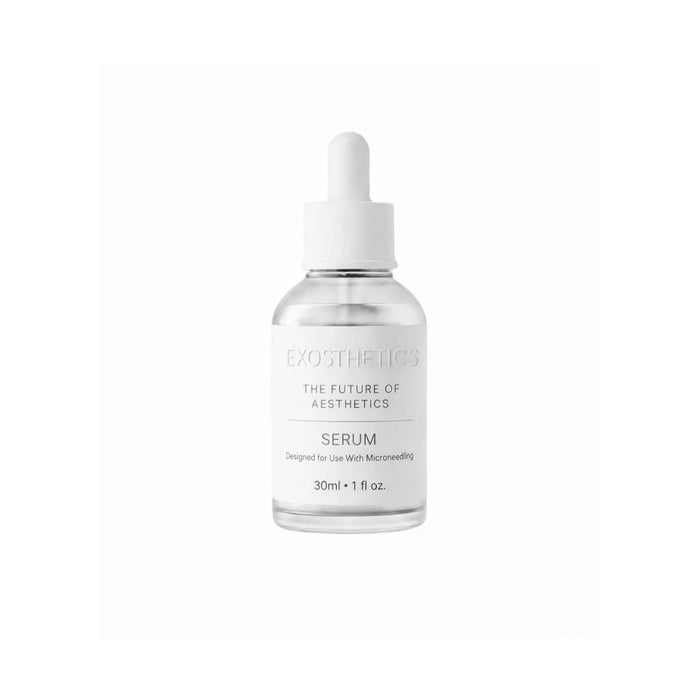
Exosome Serum for the night of. 72-Hour+ Cream from day three. $99 together, ships from the US — arrives before it gets bad.
See the Kit — $99