
Three months ago, Sarah walked into my consultation room clutching a folder of Instagram screenshots. "I've been researching laser vs microneedling for weeks," she confessed, "and I'm more confused than when I started." She's not alone. Between contradictory before-and-after claims, aggressive marketing, and a dizzying array of device names, choosing between these treatments feels overwhelming. The truth? Both can transform your skin - but only when matched correctly to your specific concern, skin type, and realistic recovery capacity. Post-treatment care and proper microneedling aftercare often determine your results more than the device itself, yet they're rarely discussed upfront.
Don't guess your recovery. Download FREE Clinical Microneedling Protocol Here
Understanding What You're Really Choosing
Here's what most providers won't tell you upfront: laser vs microneedling isn't a simple "better or worse" decision. These treatments work through fundamentally different biological pathways, trigger distinct healing responses, and carry separate risk profiles. The right choice depends entirely on what you're treating, your skin's biology, and your life circumstances.
Think of it this way - you wouldn't use a sledgehammer when you need a scalpel, and vice versa. Both are tools. Both can build something remarkable. But using the wrong one for your specific situation? That's where complications emerge.
Difference Between Laser and Microneedling
Microneedling creates mechanical injury without heat. Fine needles puncture the epidermis and superficial dermis, creating controlled microchannels that trigger your body's wound healing cascade. This mechanical trauma activates fibroblasts, stimulates collagen synthesis, and remodels tissue - all without thermal damage. The process is called percutaneous collagen induction, and it works by making your skin think it's been injured just enough to repair itself.[1]
Lasers operate on an entirely different principle: selective photothermolysis. They deliver concentrated light energy that targets specific chromophores in your skin - melanin, hemoglobin, or water - creating controlled thermal injury. That heat is the mechanism. It denatures proteins, coagulates blood vessels, and triggers a healing response that rebuilds collagen over months.[4]
The critical difference? Heat increases efficacy but simultaneously increases complication risk. Lasers can achieve more dramatic results in certain conditions precisely because thermal energy penetrates deeper and creates more aggressive remodeling. But that same thermal component makes lasers significantly riskier for darker skin types, inflammatory conditions, and patients with compromised healing.
➡️ Microneedling: Mechanical channels, minimal heat, lower risk, gradual results
➡️ Lasers: Thermal energy, chromophore targeting, higher efficacy potential, higher risk profile
Microneedling - What It Is, How It Works, and What It Treats
Microneedling excels at improving texture irregularities, fine lines, acne scars (particularly rolling scars), enlarged pores, and early-stage stretch marks.[1] It works by stimulating your body's natural wound repair mechanisms without destroying the epidermis. The controlled injury triggers three distinct healing phases: inflammation, proliferation, and remodeling.
Research demonstrates that microneedling effectively activates the skin's healing cascade, promoting collagen and elastin synthesis through mechanical trauma alone.[1] This makes it particularly valuable for patients who can't tolerate heat-based treatments or have darker skin tones where thermal injury risks post-inflammatory hyperpigmentation.
What microneedling won't do: It won't erase deep boxcar scars, fully repigment white stretch marks, or replace surgical lifting for severe laxity. Setting realistic expectations here prevents disappointment.
Recovery Forecast
Get your personalized timeline for returning to normal activities after your microneedling treatment.
Your Forecast is Ready!
Enter your email to receive your personalized recovery timeline, safe activity dates, and Exosome Accelerator calculation.
Redness Clears
Day 5
Gym Safe
Day 4
Exosome Boost
2-3 daysfaster recovery
Check Your Inbox!
Your personalized Recovery Forecast is on its way. Look for an email from Exosthetics in the next few minutes.
Laser Treatment - Types, Mechanisms, and Clinical Scope
Lasers offer precision that mechanical devices simply cannot match. By targeting specific tissue components - melanin in pigmented lesions, hemoglobin in vascular concerns, water in the dermis for resurfacing - lasers can address conditions that microneedling physically cannot reach.[4]
The laser landscape divides into two main categories, each with distinct applications and recovery profiles.
Ablative vs Non-Ablative Lasers
Ablative lasers (CO2, Erbium:YAG) vaporize the epidermis layer by layer, creating significant thermal injury that extends into the dermis. This aggressive approach delivers dramatic results for severe photodamage, deep wrinkles, and substantial scarring - but at the cost of prolonged downtime, higher infection risk, and potential for permanent pigmentary changes.[2,4]
Non-ablative lasers heat the dermis without destroying the epidermis. They're safer, require less downtime, and work well for patients who can't tolerate ablative procedures. The trade-off? Results are subtler and typically require 3-5 sessions instead of 1-2.[2]
Clinical data shows that ablative fractional lasers demonstrate superior efficacy for moderate to severe photoaging, while non-ablative systems prove safer for darker skin types and patients with limited recovery time.[2]
Laser vs Microneedling Before and After
Let's address the elephant in the room: those dramatic before-and-after photos flooding social media.

The reality of collagen remodeling: Both treatments trigger changes that unfold over 3-6 months, not overnight. Research confirms that peak collagen synthesis occurs 4-8 weeks post-treatment and continues remodeling for months.[1] Anyone showing "immediate" transformation is likely showing inflammation, not results.
Temporary worsening is normal and expected. Your skin may look worse at week 2 than before treatment. That's the inflammatory phase doing its job. Purging, increased texture, and temporary redness are part of the healing process, not treatment failure.

Red flags that should make you walk away:
❌ Perfect, identical skin texture in "after" photos (likely edited)
❌ Claims of "permanent" results (collagen continues aging)
❌ Immediate dramatic changes (that's swelling, not remodeling)
What is CO2 Laser Resurfacing? The Precision Powerhouse
CO2 laser resurfacing operates on an entirely different level of intensity. Using fractional carbon dioxide laser technology, this treatment creates columns of thermal injury that penetrate deep into the dermis – we're talking about actual vaporization of tissue.
The process essentially involves performing microsurgery on thousands of points across the skin simultaneously, removing damaged tissue and forcing the body to rebuild from scratch.
The Advanced Technology
Modern fractional CO2 lasers deliver precise beams of light at 10,600 nanometers – a wavelength perfectly absorbed by water in your skin cells. The laser creates what's called "microthermal treatment zones" that extend 1.5-4mm deep, reaching well into the dermis where serious collagen remodeling happens.
A comprehensive 2019 study in Dermatologic Surgery showed that fractional CO2 laser treatment resulted in a 35-60% improvement in deep acne scars after just one session – results that typically require 3-6 microneedling treatments to achieve.

What CO2 Laser Dominates:
- Deep, stubborn acne scars (boxcar, ice pick, rolling)
- Moderate to severe wrinkles and age spots
- Surgical scars
- Significant sun damage
- Severe skin laxity
- Long-standing stretch marks
These applications represent the most common scenarios where CO2 laser technology proves most effective.
Head-to-Head Comparison: The Complete Breakdown
|
Factor |
Microneedling |
CO2 Laser |
|
Depth of Treatment |
Shallow to mid-dermis (0.5-3mm) |
Mid to deep dermis (1.5-4mm) |
|
Downtime |
1-3 days redness |
5-14 days significant healing |
|
Pain Level |
3-5/10 (with numbing cream) |
6-8/10 (requires prescription pain management) |
|
Sessions Needed |
3-6 treatments |
1-2 treatments |
|
Cost per Session |
$200-600 |
$1,500-4,000 |
|
Total Investment |
$800-3,000 |
$2,000-6,000 |
|
Risk Level |
Low |
Moderate to High |
|
Skin Type Suitability |
All skin types |
Best for lighter skin (Fitzpatrick I-III) |
|
Return to Work |
Next day with makeup |
1-2 weeks |
|
Results Timeline |
Gradual over 3-6 months |
Dramatic within 2-3 months |
Laser vs Microneedling Cost
Laser treatments typically cost $800-3,000 per session, while microneedling ranges from $200-700.[2] But here's what matters more than per-session cost: total treatment expense.
Microneedling usually requires 3-6 sessions spaced 4-6 weeks apart. Aggressive ablative lasers might deliver comparable results in 1-2 sessions but with 7-14 days of social downtime per session. Non-ablative lasers split the difference - moderate cost, moderate downtime, but requiring 4-5 sessions.
The hidden cost nobody discusses: recovery supplies. Quality post-treatment products for barrier repair, inflammation control, and healing support can add $100-300 to your total investment - but skimping here undermines your entire treatment outcome.
Laser vs Microneedling for Wrinkles
For fine lines and early texture changes, microneedling works beautifully. The collagen induction stimulated by mechanical injury gradually plumps fine lines and improves skin quality without the risks associated with thermal devices.[1]
For deeper static wrinkles - the kind that remain even when your face is relaxed - fractional ablative lasers demonstrate superior results. The deeper thermal injury and more aggressive remodeling create tightening effects that microneedling cannot match.[4]
The honest answer? Combining both in a staged approach often delivers optimal outcomes for moderate to severe wrinkles, though this extends treatment timelines and costs.
Laser vs Microneedling for Neck
Neck skin is thin, has fewer sebaceous glands, and heals less predictably than facial skin. This anatomy changes everything.
Evidence suggests that aggressive laser resurfacing on the neck carries elevated complication risks, including prolonged erythema, pigmentary changes, and even scarring.[2,4] The neck simply doesn't tolerate thermal injury as well as thicker facial skin.
Microneedling offers a safer neck treatment option, particularly when combined with appropriate growth factors or recovery serums. The mechanical injury provides collagen stimulation without the thermal component that makes neck lasering so unpredictable.
Laser vs Microneedling for Acne Scars
Acne scars aren't a single entity - they're a category with distinct subtypes requiring different approaches.
Rolling scars (gentle depressions with sloped edges) respond excellently to microneedling. The collagen remodeling gradually elevates the depressed areas through fibroblast activation.[1]
Boxcar and ice-pick scars benefit more from fractional laser resurfacing, particularly fractional CO2, which can ablate scar tissue and trigger more aggressive remodeling.[2] The precision thermal injury reaches depths that needle penetration cannot.
Clinical studies demonstrate that both modalities improve acne scarring, but patient selection - matching scar morphology to treatment mechanism - determines outcome quality more than device choice alone.[1,2]
Laser vs Microneedling for Stretch Marks
Let me be direct: no treatment fully erases mature stretch marks. Both lasers and microneedling can improve texture and slightly narrow width, but expecting complete removal sets you up for disappointment.
Research shows that both modalities trigger collagen remodeling in striae (stretch marks), improving appearance through increased dermal thickness and better texture.[1,3] However, repigmentation of hypopigmented striae remains challenging regardless of technology used.
Realistic expectations: 30-50% improvement in appearance, primarily through texture smoothing and slight color blending - not elimination.
Laser vs Microneedling for Pores
Both treatments reduce apparent pore size through the same underlying mechanism: building collagen support around follicles. The improvement isn't about "shrinking" pores (they don't have muscles), but rather creating structural support that prevents sagging and enlargement.[1]
Microneedling works well here with minimal downtime. Multiple sessions create gradual, natural-looking refinement without the risks of aggressive lasering.
Laser vs Microneedling for Rosacea
This is where lasers clearly win. Vascular lasers (PDL, KTP, Nd:YAG) directly target hemoglobin in dilated blood vessels, coagulating the abnormal vasculature that creates rosacea's persistent redness.[4]
Microneedling has limited value in active rosacea and may actually trigger flares through mechanical irritation. If you have significant vascular rosacea, targeted laser therapy - not microneedling - is the evidence-based choice.
Laser vs Microneedling for Scars
For traumatic scars or surgical scars, fractional lasers offer superior depth precision and can address both color and texture components simultaneously.[2] The ability to control penetration depth and pattern density allows customization that mechanical needling cannot match.
However, microneedling remains safer for darker skin types (Fitzpatrick IV-VI) where laser-induced post-inflammatory hyperpigmentation poses significant risk.[2] When treating patients with rich melanin, microneedling's heat-free mechanism becomes its greatest advantage.
Laser vs Microneedling for Hyperpigmentation
Here's where treatment selection becomes critical: heat can induce or worsen hyperpigmentation.
Laser treatments targeting pigment work by creating controlled thermal injury to melanin-containing cells. In lighter skin types, this can effectively fade sun damage and age spots. But in Fitzpatrick types IV-VI, that same thermal mechanism frequently triggers reactive post-inflammatory hyperpigmentation that's worse than the original concern.[2,4]
Clinical evidence supports microneedling as the safer approach for darker skin tones requiring pigment improvement, particularly when combined with appropriate topical lightening agents.[2]
Laser vs Microneedling for Melasma
Critical warning: Most lasers can worsen melasma. This hormonally-driven pigmentation disorder responds unpredictably to thermal injury, and many patients experience darkening rather than lightening after laser treatment.[4]
Microneedling plays an adjunctive role in melasma management - creating channels for better penetration of topical tyrosinase inhibitors - but it's not a standalone solution. Melasma requires comprehensive management addressing its multifactorial triggers (hormones, UV exposure, inflammation), not just procedural intervention.
Related: Ultra Clear laser recovery and Clear and Brilliant vs microneedling
Advanced Strategies: Maximizing Your Results
The Combination Approach
Leading dermatologists increasingly recommend combination protocols for optimal results:
Protocol Example:
- Month 1: Microneedling to prime collagen production
- Month 3: Second microneedling session for continued improvement
- Month 6: CO2 laser for dramatic finishing results
- Month 9: Final microneedling for maintenance
This combination approach offers the safety profile of microneedling with more dramatic finishing results, allowing patients to build confidence with the gentler treatment before committing to more intensive procedures.
Post-Treatment Care - Where Results Actually Happen
Your skin's barrier is compromised after both lasers and microneedling. That vulnerability is exactly what triggers the healing cascade that delivers results, but it also creates a critical window where poor care can undermine everything.
What your skin needs in the first 72 hours:
-
Barrier repair ingredients (ceramides, cholesterol, fatty acids)
-
Anti-inflammatory support (without suppressing the healing response)
-
Growth factor signaling to guide collagen synthesis
-
Protection from UV, environmental pollutants, and mechanical trauma
Research demonstrates that supporting the inflammatory phase without suppressing it, while simultaneously providing the molecular signals that guide optimal collagen remodeling, significantly impacts final outcomes.[1,3]
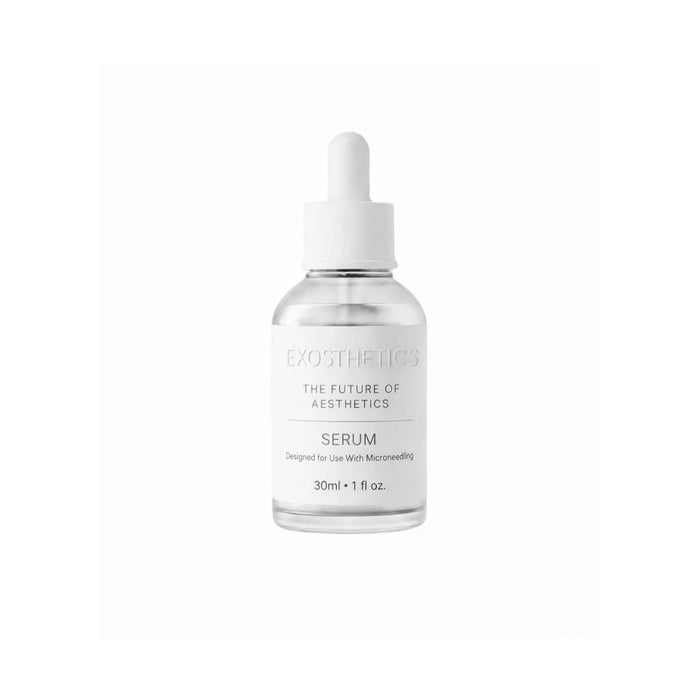
This is where thoughtfully formulated recovery products become invaluable - like the latest Exosthetics Microneedling Recovery Serum specifically for this critical post-treatment window - combining exosome technology with barrier repair ingredients to support your skin's natural healing process without interfering with the remodeling cascade. It's designed to work with your biology, not against it.
Do's and Don'ts After Treatment
✅ DO:
-
Space treatments minimum 4-6 weeks apart
-
Use gentle, pH-balanced cleansers
-
Apply mineral-based sunscreen religiously (SPF 30+ minimum)
-
Sleep on clean pillowcases
-
Let peeling/flaking happen naturally
❌ DON'T:
-
Stack aggressive procedures without adequate healing time
-
Use active ingredients (retinoids, AHAs, vitamin C) for 3-7 days post-treatment
-
Interpret inflammation as treatment "success"
-
Pick, scrub, or force exfoliation
-
Exercise vigorously for 24-48 hours (sweat increases infection risk)

Comprehensive Laser Systems vs Microneedling Comparison
|
System |
Mechanism |
Depth |
Downtime |
Best Indication |
Risk Level |
Suitable Skin Types |
|
Halo (Hybrid Fractional) |
Ablative + non-ablative |
200-1500 microns |
5-7 days |
Comprehensive photoaging |
Moderate |
I-IV |
|
BBL (Broadband Light) |
IPL, non-ablative |
Superficial |
1-2 days |
Pigment, vascular |
Low |
I-III |
|
Q-Switch |
Pigment targeting |
Dermal |
7-10 days |
Tattoo removal, deep pigment |
Moderate |
I-V (with caution) |
|
Pico/PicoSure |
Ultra-short pulse |
Variable |
2-3 days |
Pigment, tattoos, texture |
Low-Moderate |
I-V |
|
Erbium:YAG |
Ablative, water targeting |
50-100+ microns |
5-10 days |
Moderate wrinkles, scars |
Moderate-High |
I-IV |
|
Moxi |
Non-ablative fractional |
Superficial |
1-3 days |
Maintenance, mild texture |
Low |
I-V |
|
Morpheus8 (RF+needling) |
Radiofrequency + needles |
Up to 4mm |
3-5 days |
Deep tightening, all skin types |
Moderate |
I-VI |
|
VBeam (PDL) |
Vascular targeting |
Superficial-mid dermis |
5-7 days (purpura) |
Rosacea, broken vessels |
Low-Moderate |
I-V |
|
Nd:YAG |
Deep vascular/hair |
Deep dermal |
1-3 days |
Deep vessels, hair removal |
Low-Moderate |
I-VI |
|
Laser Genesis |
Non-ablative |
Superficial |
None |
Redness, fine lines |
Very Low |
I-V |
|
IPL (Intense Pulsed Light) |
Broadband, multi-target |
Superficial |
2-5 days |
Sun damage, vessels |
Low |
I-III |
|
Fraxel (Fractional) |
Non-ablative fractional |
400-1500 microns |
3-5 days |
General photoaging |
Moderate |
I-IV |
|
CO2 (Fractional/Full) |
Ablative, deep resurfacing |
200-2000+ microns |
7-14 days |
Severe damage, deep scars |
High |
I-III |
|
Microneedling |
Mechanical, no heat |
0.5-3mm controlled |
1-3 days |
Texture, scars, all skin types |
Low |
I-VI |
|
Microneedling + PRP/Exosomes |
Mechanical + growth factors |
0.5-3mm controlled |
1-3 days |
Enhanced healing, texture |
Low |
I-VI |
Note: Downtime and risk levels are generalizations - individual responses vary significantly.
FAQ
Which is better, laser or microneedling?
Neither is universally superior. Lasers excel at targeting pigment, blood vessels, and achieving deeper thermal remodeling. Microneedling offers safer texture improvement for darker skin types and conditions where heat poses risks. Your specific concern, skin type, and risk tolerance determine the right choice.
Should microneedling be done before or after CO2 laser?
Many dermatologists recommend microneedling first as a "primer" treatment, followed by CO2 laser for finishing results. This combination approach can provide 80% of laser benefits with reduced risks.
What is more effective, laser or microneedling?
Effectiveness is indication-specific, not device-specific. Lasers deliver better results for vascular rosacea, melasma (carefully selected types), and deep wrinkles. Microneedling outperforms for rolling acne scars and texture refinement in darker skin types where laser-induced hyperpigmentation is likely.
Does microneedling or laser hurt more?
Lasers generally cause more intense discomfort due to thermal injury sensation, often described as rubber band snapping or hot pinpricks. Microneedling creates mechanical pressure sensation but is typically better tolerated with topical anesthesia. Pain tolerance varies individually.
Which is more expensive, laser or microneedling?
Laser treatments cost $800-3,000 per session versus microneedling's $200-700 range. However, total treatment cost depends on sessions required - microneedling needs 4-6 treatments while aggressive lasers may achieve results in 1-2. Factor in downtime costs and recovery products for true comparison.
Choosing Between Laser vs Microneedling - Your Personalized Decision
There's no universal winner in this comparison because your skin isn't universal - it's uniquely yours, with its specific biology, healing capacity, lifestyle constraints, and aesthetic goals.
The correct answer emerges from three factors working together: matching treatment mechanism to indication + proper technique + committed aftercare protocol. Miss any of these three elements, and outcomes suffer regardless of how much you spend or which device your provider uses.
One final truth that too few providers share: over-treatment damages more skin than under-treatment. The pressure to "do something" drives patients toward aggressive protocols that compromise barrier function and create chronic inflammation. Sometimes the most sophisticated medical decision is strategic patience - spacing treatments appropriately, supporting recovery completely, and letting biology do its remarkable work.
The technology matters. The research matters. But your skin's innate healing wisdom, when properly supported, matters most of all.
References
Iriarte C, Awosika O, Rengifo-Pardo M, Ehrlich A. Review of applications of microneedling in dermatology. Clin Cosmet Investig Dermatol. 2017;10:289-298. PMID: 26845539
Soleymani T, Lanoue J, Rahman Z. A Practical Approach to Chemical Peels: A Review of Fundamentals and Step-by-step Algorithmic Protocol for Treatment. J Clin Aesthet Dermatol. 2018;11(8):21-28. PMID: 36749436
Almohanna HM, Khayat O, Griggs J, et al. The Role of Growth Factors and Cytokines in the Pathogenesis of Psoriasis: A Comprehensive Review. Biomedicines. 2023;11(10):2793. PMC: PMC10564192
Alshahrani MA, Binamer Y. Complications and Management in Laser Dermatology: A Comprehensive Review. Cureus. 2024;16(3):e56306. PMC: PMC10978375

The first week
Everything in this guide, in two products
Exosome Serum for the night of. 72-Hour+ Cream from day three. $99 together, ships from the US — arrives before it gets bad.
See the Kit — $99